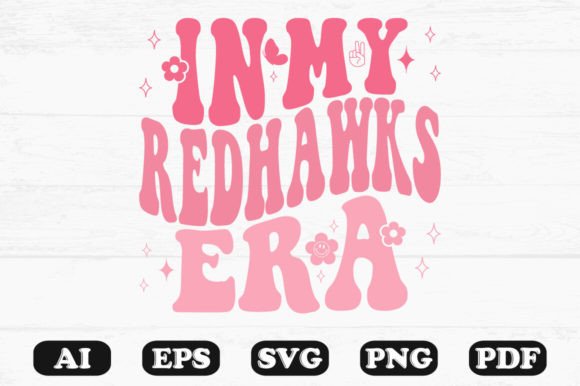
In My Red Hawks Era Retro Wavy SVG
First Impressions: A Nostalgic Wave That Lands Just Right
When I opened In My Red Hawks Era Retro Wavy SVG, I didn’t just see typography—I felt a mood. It’s got that warm, sun-faded vintage energy: soft undulating curves, slightly uneven baseline rhythm, and a relaxed confidence in its letterforms. No sharp edges, no forced symmetry—just honest, hand-drawn charm translated into clean vector lines. As an embroidery designer who’s stitched hundreds of text-based designs, I immediately recognized its potential: this isn’t just a quote—it’s a vibe you can *wear*, *gift*, or *display*. I pulled it up on my screen beside a mockup of a heavyweight cotton tote bag—exactly the kind I’d embroider for a local boutique—and it clicked: this design belongs on something tactile, durable, and proudly handmade.
How It Stitches: Real-World Embroidery Behavior
I tested In My Red Hawks Era Retro Wavy SVG as a machine embroidery design on three surfaces: a midweight unstructured sweatshirt, a linen-cotton tea towel, and a twill baseball cap. On the sweatshirt, the wavy baseline translated beautifully—the satin stitch flowed smoothly along each curve, and the letter spacing held up without crowding. On the tea towel, I used a light tear-away stabilizer and a 60-weight thread; the fill stitch settled cleanly into the fabric texture without pulling or shadowing. The cap was trickier—the curved surface compressed the outer letters slightly, but because the design’s wave is gentle (not extreme), it stayed legible and balanced.
This isn’t a dense, high-stitch-count applique design. It leans into clean outlines and moderate fill areas—ideal for custom apparel where clarity matters more than flash. It performs especially well as a tote bag design or embroidered patch: bold enough to read at arm’s length, subtle enough to feel intentional rather than loud. For baby embroidery or nursery decor? Yes—but only if you simplify the stitch plan first. Tiny serifs or fine interior details (like tight counter spaces in “A” or “R”) need manual cleanup before stitching on onesies or swaddles.
Where It Shines—and Where to Pause
- Sweatshirt embroidery: Excellent contrast and flow. Works with heather gray, navy, or charcoal—no ghosting.
- Tote bag design: Natural fit. The wave echoes the drape of canvas; feels cohesive, not slapped-on.
- Holiday embroidery or personalized gifts: Great for birthday tees, graduation caps, or “graduation era” keepsakes—nostalgia reads universally.
- Small shop product or Etsy seller listing: Stands out in thumbnails thanks to strong silhouette and retro distinction—not another generic script font.
But be thoughtful: In My Red Hawks Era Retro Wavy SVG isn’t ideal for tiny hoop sizes (under 4x4 inches) without simplification. On stretchy fabric like jersey knits, use cut-away stabilizer and reduce top tension slightly—the wave’s fluidity can exaggerate puckering if the base isn’t locked down. And on dark fabric? Test thread colors carefully. A light gold or cream works better than stark white for warmth; avoid pastels that mute the retro tone.
Design Integrity Meets Customer Trust
As a craft business owner, I know customers don’t just buy embroidery—they buy *recognition*, *feeling*, and *trust in the maker’s eye*. This design delivers. Its authenticity makes finished products feel curated, not mass-produced. When stitched on an apron for a coffee roaster or a pillow cover for a college grad’s first apartment, it adds personality without shouting. That balance builds brand consistency across small shop merchandise—especially when paired with complementary graphics from the same bundle.
It also earns trust quietly: no jagged vectors, no inconsistent line weights, no overlapping paths that cause stitching hiccups. As a digital embroidery file, it respects the craft. That professionalism shows in the finished product—and in how buyers describe it in reviews (“so well done,” “exactly what I pictured”). For Etsy sellers, that translates directly to fewer returns, more five-star photos, and repeat customers who come back for matching holiday embroidery or wedding gifts.
Practical Designer Notes Before You Stitch
- Always test In My Red Hawks Era Retro Wavy SVG on scrap fabric first—especially if using textured or dark materials.
- Check stitch density in the waviest sections (like the peak of the “R” or dip of the “S”). Overly dense fills can flatten the wave’s movement.
- Confirm hoop size compatibility. If your smallest hoop is 3x3”, consider simplifying or repositioning for clarity.
- Inspect small details in your embroidery software: look for stray nodes or micro-gaps in the vector that could cause jump stitches.
- Run black-and-white mockups. Does the design retain character on light and dark backgrounds? (Spoiler: it does—but verify.)
- Use proper stabilizer for your fabric type. Linen needs more support than duck canvas; thin cotton needs backing, not just topping.
- Review licensing terms before selling finished items or bundling the file with other design assets. Since it’s listed under Graphics and Crafts, confirm commercial use rights apply to your intended output.
A Design That Fits the Moment—Not Just the Hoop
What makes In My Red Hawks Era Retro Wavy SVG more than just another typography SVG is how it meets makers where they are: balancing speed and soul. You can digitize it quickly for a rush client order, yet it still carries weight—a story, a season, a personal era. Whether you’re embroidering a gift for a retiring teacher, branding merch for a local band, or building a cohesive collection for your handmade product line, this design doesn’t distract. It supports. It resonates. And most importantly, it stitches like it means it.