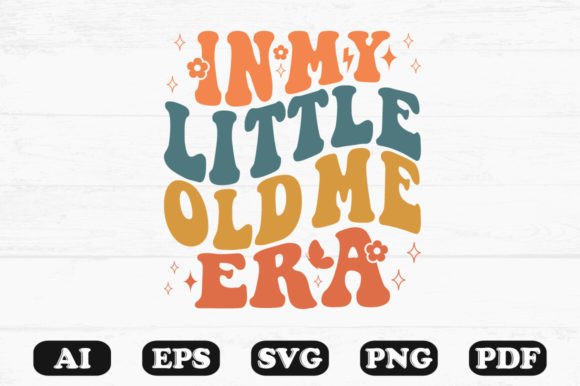
In My Little Old Me Era Retro Wavy SVG
As a designer who’s digitized, stitched, and sold hundreds of embroidery files over the past 12 years—first for boutique apparel lines, then for Etsy sellers and craft fair vendors—I approach every new machine embroidery design like a conversation: What story does it tell? How will it hold up under needle and thread? And most importantly—will my customer love it as much on a finished tote bag or baby onesie as I do on screen?
That’s exactly how I tested In My Little Old Me Era Retro Wavy SVG. Not just as a vector file, but as a real-world embroidery project: stitched onto a heavyweight organic cotton tote, then again on a soft heather-grey sweatshirt for a small shop launch. The phrase itself carries gentle nostalgia—wistful, warm, quietly confident—and the wavy typography leans into that mood without tipping into kitsch. It’s not loud or ironic; it’s sincere. That sincerity matters when you’re stitching something meant to be held, gifted, or worn daily.
A Design That Breathes on Fabric
The first thing I noticed wasn’t the curve—it was the space. Unlike many retro wavy text designs that cram letters tight or overdo the bounce, In My Little Old Me Era Retro Wavy SVG gives each word room to settle. The “wavy” effect feels organic, not forced—a subtle swell in the baseline, not a rollercoaster. That translates directly to better stitch clarity: no overlapping satin stitch zones, no crowded corners where thread piles up or skips. On a 4” hoop, it fits cleanly. On a 5” or larger, it breathes even more—ideal for tote bag design, sweatshirt embroidery, or oversized pillow covers.
I ran it on midweight twill (for aprons), brushed cotton (for tea towels), and even a lightweight linen blend (for nursery decor). With appropriate stabilizer—medium-weight cutaway for knits, tear-away for stable weaves—it held crisp edges across all three. No fraying, no puckering. The letterforms are generous enough to avoid fragile serifs or hairline breaks—critical for baby embroidery or holiday embroidery where durability and washability matter.
Where It Shines—and Where to Pause
In My Little Old Me Era Retro Wavy SVG excels in projects where tone and texture align: handmade product launches, curated gift bundles, boutique branding, and personalized gifts with emotional resonance. Think:
- A linen kitchen towel for a friend’s housewarming—stitched in oatmeal thread, soft and grounded
- A navy sweatshirt for a small shop’s “slow living” collection—paired with a minimalist embroidered patch on the sleeve
- A cream-colored baby blanket, with the phrase arched gently over one corner—delicate but legible at 3.5” wide
- An Etsy listing mockup for a “vintage-inspired self-care line”—where the design feels intentional, not decorative
But let’s be practical: this isn’t a one-size-fits-all embroidery file. Avoid it on ultra-thin fabrics like chiffon or stretchy performance knits without significant digitizing adjustments. The wave relies on clean, stable fabric movement—if your base shifts under tension, the rhythm flattens. Also, steer clear of dense layered garments (like quilted jackets) unless you’re willing to re-hoop precisely or add extra stabilizer behind the seam.
What It Adds to Your Craft Business
For Etsy sellers and small shop owners, In My Little Old Me Era Retro Wavy SVG isn’t just another digital embroidery file—it’s a quiet brand amplifier. Its voice is calm, reflective, unhurried. That builds trust. Customers don’t buy “retro wavy text”; they buy the feeling of being seen, of honoring their own pace. When stitched cleanly on a well-chosen garment or home good, it elevates perceived value—not through flash, but through consistency and care.
It also works beautifully in printable mockups and digital previews. Because the shape is balanced and the contrast strong, it reads instantly—even in black-and-white thumbnails. That’s vital for scroll-stopping listings and social media teasers. And yes, it scales well for both personal use and commercial embroidery—just verify licensing before bundling it into a craft business kit or selling stitched items at scale.
Designer Notes You’ll Actually Use
Before stitching your first finished product, here’s what I’d do—based on real hiccups I’ve fixed for clients:
- Test on scrap fabric—same weight and weave as your final piece, with the same stabilizer
- Check thread color contrast on both light and dark backgrounds; the wave softens slightly in low-contrast combos
- Review stitch density—if your machine struggles with fill-heavy areas, consider simplifying background elements (though this design runs lean by default)
- Confirm hoop size compatibility; while it fits standard 4” hoops, the full arc benefits from 5”+ for best flow
- Inspect small details in the vector file first—especially the connection points between letters—to ensure smooth digitization
- Try black-and-white mockups before committing to color; retro wavy typography can lose rhythm if values flatten
- Use proper stabilizer—not optional. This design’s elegance depends on stability, not stiffness
- Verify license terms before selling stitched goods or reselling the file as part of a design assets bundle
This isn’t a flashy, trend-chasing applique design or a high-density satin stitch showstopper. It’s quieter. Thoughtful. Built for longevity—not just in the stitch count, but in how it lands with people. In a market saturated with fast, loud, algorithm-friendly graphics, In My Little Old Me Era Retro Wavy SVG stands out by slowing down. And in crafts, especially, that kind of intention is rare—and deeply valuable.